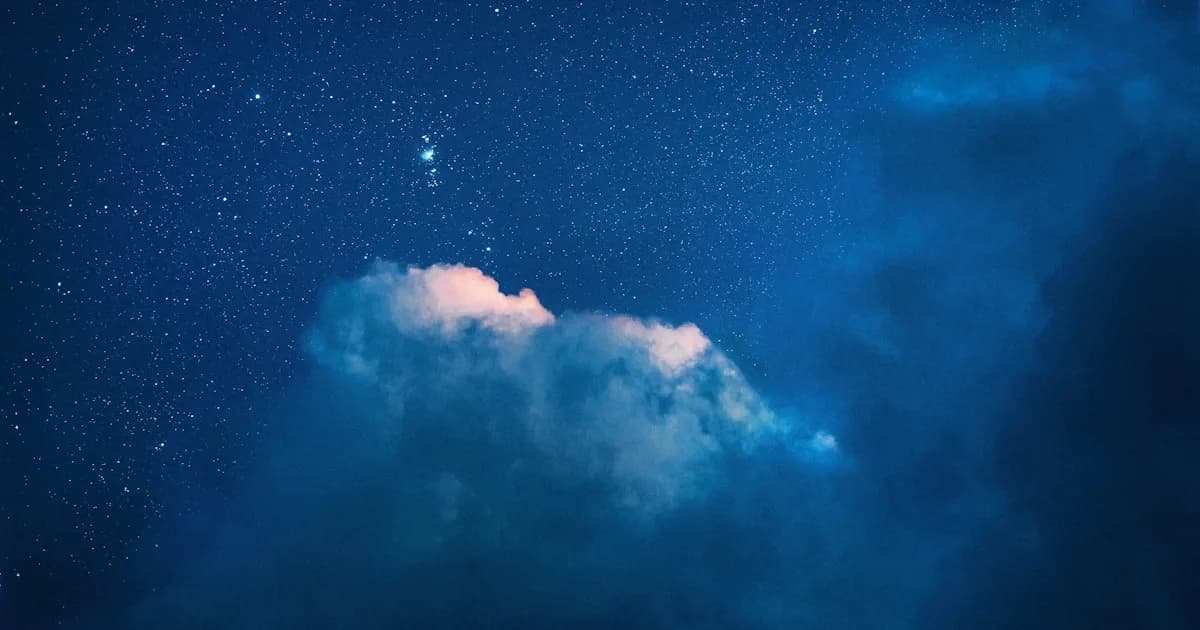
If you've encountered stars in your dreams, you've been visited by one of the most ancient and persistent images in human experience. Stars appear in dreams across cultures, in moments of searching and wonder, in periods of confusion and clarity. A dream about stars may be connected to aspiration, to distance, to guidance—or to something far more personal that only you can know. Before asking what these images mean, the first question is always about your own encounter: What was it like to see them? What did you feel?
The Emotional Register of Stars in Dreams
The experience of encountering stars in a dream typically arrives with a specific emotional signature—one that precedes any interpretation or symbolic meaning. Pay attention to what you felt in the moment of seeing them. Was it awe? A kind of vertigo at immensity? Loneliness? Relief? A sense of direction? Wonder mixed with melancholy? These emotional responses are not secondary to the dream—they are the dream's primary communication. The feeling is the message, arriving before you have any words for it.
For many dreamers, stars carry a particular quality of emotion: the longing to understand something vast and distant, combined with the awareness that some things remain beyond complete knowing. There is an intimacy in starlight that is also impersonal—the light from stars that burned out eons ago reaches us now, present and absent simultaneously. A dreamer who encountered stars in their dream has been held, for a moment, in that paradox. What is your relationship with that feeling?
Reflection: Your Personal Relationship with This Image
Stars in dreams do not arrive as generic symbols. They arrive in relationship with the specific dreamer—your history, your current moment, what you have been thinking about and what you have been avoiding. The question beneath all reflection about dream symbols is this: What relationship do I already have with this image, before any interpretation begins?
Have you encountered stars in waking life in a way that shaped you? Did you spend childhood looking up at them? Do they connect to a place you loved, a time in your life, a person? Do stars appear in stories or myths that matter to you? Or are they simply distant—present in the sky but not in your emotional memory? All of this context shapes what the stars in your dream are communicating. The same image arrives differently to someone who grew up under a clear night sky and someone who has lived most of their life in a city where stars are invisible.
Consider also: What is happening in your life at the moment this dream arrived? Are you reaching for something—a goal, a relationship, a clarity about your direction? Are you feeling lost? Overwhelmed? Hopeful? The timing of a dream is always part of its meaning. A dream about stars during a period when you are searching carries different weight than the same dream during a period of belonging. Why might this image be appearing now, in this particular moment of your life?
Pay attention also to your position in the dream. Were you looking up at the stars, or were you among them? Were you still, or moving? Were you alone, or was someone with you? Were you trying to reach them, or simply witnessing them? The dreamer's relationship to the image—whether observer or participant, whether reaching or receiving—is itself material worth exploring. Who are you in this dream, and what does your position suggest about your relationship with what the stars represent?
Cultural and Psychological Contexts for Star Imagery
Throughout human history and across many traditions, stars have carried distinct meanings—though none of these is the correct reading of your dream. They are offerings of vocabulary, ways of naming what you have already felt. Some contexts may illuminate; others may not resonate at all. Take what is useful and leave what is not.
In many Western spiritual traditions, stars have been associated with guidance, with divine presence, with the soul or the higher self. The idea of a guiding star—the star that leads to something essential—appears in myth and religious narrative across cultures. In astrology, stars and their constellations have been read as mirrors of human fate and character. In Jungian psychology, stars sometimes appear as symbols of the Self—the center of the psyche, the wholeness that the conscious mind is gradually approaching. The light of a star is ancient light, carrying information from the past into the present, which may connect to themes of inherited wisdom or ancestral presence.
In neuroscience, the night sky—and particularly stars—activates the human sense of awe, a distinct emotional state that involves a sense of vastness beyond our understanding combined with the need to process that vastness somehow. Awe is not fear; it is wonder mixed with a kind of humility at encountering something larger than ourselves. This may be part of what your dream is generating: not interpretation, but the activation of awe itself as a state of consciousness.
Some dreamers report stars as connected to longing—specifically, the longing for something that exists but is unreachable, or the search for clarity in confusion. Others experience them as reassurance, a reminder that light persists even in darkness. Still others encounter them as symbols of infinity, of the vastness within themselves that they have not fully acknowledged. What matters is not which of these contexts is correct, but which ones—if any—echo something true in your own experience of the dream.
Deepening Your Relationship with This Dream
Dreams about stars do not need to resolve into a single meaning. The most valuable work you can do with this dream is to remain in relationship with it—to let it continue to speak to you over time, rather than arriving at a conclusion and moving on. Dream practice is longitudinal; understanding accumulates slowly.
Consider keeping a record of this dream in a journal. Write down not just the facts of the dream, but the feeling it left with you. Return to it periodically—in a week, in a month. Notice whether new details emerge, whether your emotional response shifts, whether connections to your waking life become clearer. If stars recur in your dreams, track them: Are they the same stars? Do they change? What is different in your life when they appear?
You might also try a simple meditation with the image. Find a quiet moment and close your eyes. Call to mind the star dream as vividly as you can. Rather than analyzing it, simply sit with it. Notice what feelings arise, what words want to come, what associations emerge. You are not looking for the interpretation; you are deepening your familiarity with the material. Many dreamers find that understanding arrives not through analysis but through prolonged attention—through allowing the image to work on them slowly, the way starlight itself arrives across vast distances.
If you are drawn to working with this image more actively, consider dream incubation: the practice of intentionally preparing yourself to engage with a theme before sleep. You might spend a few minutes before bed thinking about the stars in your dream, holding a question gently in mind. What do you want to understand about them? Why did they appear? What are they showing you? This is not a demand but an invitation—an opening for your dreams to continue the conversation.
What Remains Open
It is possible that your dream about stars will never resolve into a clear meaning. It may remain luminous and mysterious, beautiful and inexplicable. This is not a failure. Some of the most significant dream experiences are the ones that resist interpretation entirely, that ask us to live with the wonder rather than solve the puzzle. The dream has already done its primary work: it has brought you into encounter with starlight, with vastness, with the emotion that arises when you contemplate something larger than yourself. That encounter may be enough. That encounter may be the entire point.
What would it feel like to hold this dream without needing to explain it? What would open if you allowed the stars to remain mysterious, even as you continue to look at them?