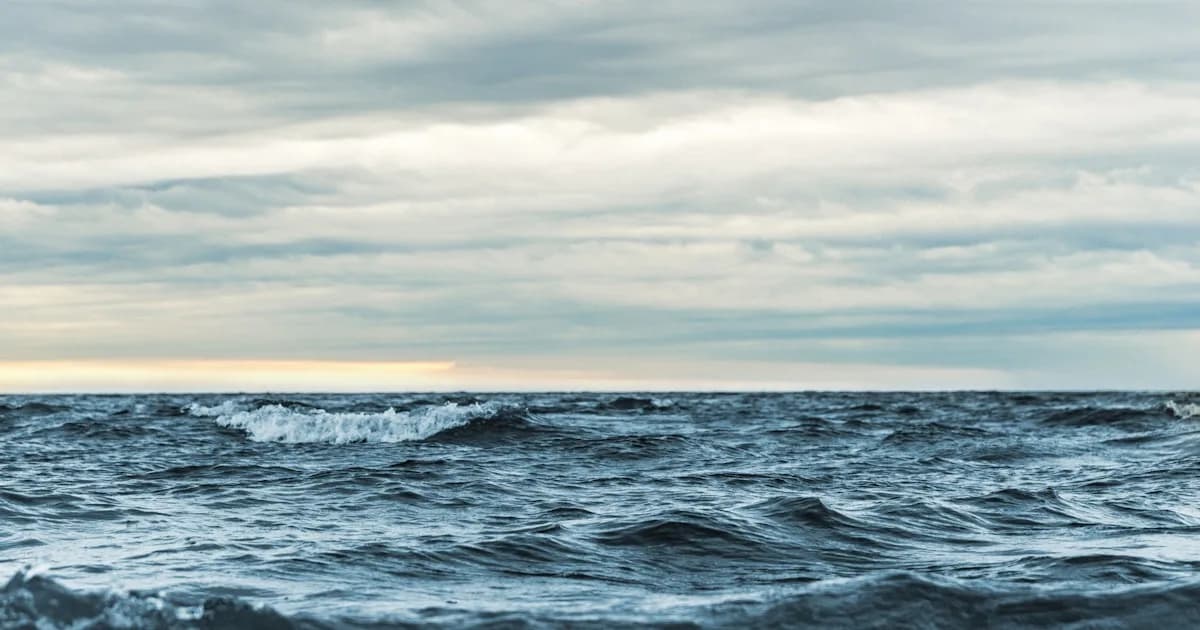
If the sea has appeared in your dream, you have encountered one of the most evocative and complex symbols the unconscious mind can offer. Water — especially the vast, boundless sea — carries weight in dreams that few other images do. Before asking what this dream means, it is worth pausing to notice: what did it feel like to be there? Was there a sense of awe, or unease, or longing, or something harder to name? The emotional texture of your encounter with the sea is the first material worth attending to.
The Emotional Register of Water in Dreams
Dreams of the sea are rarely neutral. The experience of standing before an expanse of water — whether calm or turbulent — generates feeling before it generates meaning. Some dreamers report a profound peace, a sense of homecoming or belonging. Others describe a vertigo, a fear of what lies beneath the surface or beyond the horizon. Still others speak of a strange magnetism, a pull toward something vast that both attracts and unsettles them. These emotional responses are not incidental to the dream's significance. They are the dream's primary communication. Before you reach for symbolic interpretation, sit with what you felt. Did the sea feel safe or threatening? Familiar or alien? Did you want to enter it, or retreat from it? Did you feel small before it, or somehow contained by it? The dreamer who begins with emotion rather than meaning is working directly with the material the unconscious has produced. The fear or peace you felt in the dream is not a secondary effect — it is the dream itself, speaking.
Why Now? The Sea as Timing and Context
A crucial question in any dream work is not merely what the symbol is, but why it is appearing now. The sea that arrives in a dream during a period of transition carries different weight than the sea that appears during relative stability. The sea that surfaces when you are facing a major decision or upheaval may be showing you something about the uncertainty you are navigating — the sense of standing at a threshold, unable to see across. Consider the context of your waking life at the moment this dream appeared. Were you in a period of change? Were you grieving? Were you on the edge of a new beginning? Were you feeling lost or directionless? The timing of the sea's arrival, the specific moment in your life when your unconscious chose to produce this image, is part of the dream's message. This is not superstition. It is the recognition that dreams arise in relationship with what is happening in our lives. They respond to our inner state, often showing us what we are not yet able to articulate in waking thought. The question "why now?" often opens more understanding than the question "what does this mean?"
Multiple Meanings: Water as Boundlessness and Uncertainty
Across cultures and psychological traditions, water has been connected to many different domains of human experience. Some Jungian analysts have understood it as a symbol of the unconscious itself — boundless, powerful, partially known. Others have read it as emotional depth, the realm of feeling beyond rational control. In many Indigenous traditions, water is sacred, a life-giving force that connects all beings. In alchemical symbolism, water represents dissolution and transformation. But here is what matters: none of these readings is the correct one for your dream. What the sea means depends entirely on your own relationship with it, your personal history with water, your life circumstances at the moment the dream appeared. A dreamer who grew up by the ocean may encounter the sea very differently from someone who grew up in a landlocked region. A dreamer who nearly drowned will feel something different in the presence of dream-water than someone who loves to swim. A dreamer who is currently grieving may find the sea speaks to loss, while a dreamer in early love may find it speaks to boundless possibility. All of these readings are legitimate. All of them are potentially true simultaneously. The richest dream work does not force these meanings into a hierarchy. It allows them to coexist, recognizing that the sea in dreams carries more meaning than any single interpretation can hold.
The Questions Worth Sitting With
Rather than reaching for a conclusion about what your sea dream means, consider spending time with these questions. Write about them, meditate on them, carry them with you across several days. Do not expect immediate answers. Some of the most valuable dream work happens in the space between the question and whatever understanding eventually arrives. What is your personal relationship with the sea? Have you lived near it, feared it, loved it, avoided it? What memories or associations come up when you think of the ocean? These personal connections are the foundation on which everything else builds. Who were you in the dream? Were you a participant, wading in or swimming? Were you an observer, standing on shore? Were you somehow both at once? And crucially — did your sense of self shift during the dream? This fluidity of identity in dreams is itself material worth exploring. What would it mean if you stayed with this dream longer, without needing to resolve it into a clear interpretation? Many dreamers report that the most significant insights come not from quick understanding but from patient, repeated engagement with the same image over weeks or months. The sea that puzzles you today may become clearer in six months, or it may develop new dimensions you could not have anticipated.
Cultural and Psychological Contexts
If it feels useful, here are some possible languages that traditions have offered for understanding water in dreams. Take what resonates. Leave what does not. In depth psychology, water often represents the realm of the unconscious — everything in the psyche that consciousness does not directly control. The sea, specifically, with its vastness and power and unknowability, may speak to the depths of the unconscious that lie beyond our conscious understanding. Drowning in dream-water might then suggest being overwhelmed by unconscious material; swimming easily might suggest comfort with the non-rational dimensions of the self. In many spiritual traditions, water is understood as a purifying or renewing force. A dream of entering the sea might be connected to themes of cleansing, rebirth, or release. In Christian tradition, water baptism represents transformation and new beginning. In many Indigenous traditions, water is understood as the blood of the earth, sacred and life-sustaining. Psychologically, water also represents emotion — the realm of feeling beyond the reach of rational thought. A turbulent sea might reflect emotional turbulence in your inner or outer world. A calm ocean might reflect emotional equilibrium. But again, this reading works only if it resonates with your own experience. In some traditions, the boundlessness of the sea represents both potential and terror — the recognition that life is fundamentally uncertain, that we cannot control or fully predict what will happen. Standing before the sea in a dream might be your psyche's way of acknowledging this truth, or learning to live with it.
Practices for Deepening Your Relationship With This Dream
If this dream feels significant to you, it is worth continuing to engage with it. Here are some concrete practices that may help you develop a deeper relationship with the material. First, record the dream in as much detail as you can remember. Not just the plot, but the emotional texture, the colors, the sensations. If the sea was warm or cold, if the sand was rough or smooth, if the air held salt or other scents — these details are part of the dream's language. As you write, you may notice elements that did not surface in your initial memory. Second, spend time with the image in meditation or visualization. Close your eyes and return to the dream-sea. Do not try to change it or analyze it — simply be there, noticing what happens. Sometimes the dream will offer new information, or deepen in ways that written analysis cannot reach. If you choose to enter the sea in this visualization, notice what happens. If you choose to remain on shore, notice that too. Both choices are meaningful. Third, notice whether the sea appears again in your dreams or in your waking thoughts. Sometimes an image that appears once is simply marking a moment. Sometimes it is the beginning of a conversation. A recurring image, attended to over time, reveals patterns and depths that a single dream cannot show. Finally, consider: what would it feel like to live differently in relation to what this dream is showing you? If the sea speaks to boundlessness, what would it mean to embrace more uncertainty in your waking life? If it speaks to emotional depth, what would it mean to honor your feelings more fully? The dream is not prescriptive — it is not telling you what to do. But it may be inviting you to notice something about how you are living that deserves attention.
Living With What the Sea Cannot Tell Us
Some dreams remain partially mysterious. Some images in dreams never fully resolve into clear meaning, and this is not a failure of the dream work — it is part of what makes dreams psychologically valuable. The sea, with all its vastness and depth, may be showing you something that your conscious mind cannot yet articulate. That is not a problem to be solved. It is an encounter worth honoring. You might sit with the dream without needing it to mean anything in particular. You might notice that the longer you hold the image, the more you simply accept its strangeness and power, the more you change in relation to it. This shift in you — this deepening comfort with mystery, this increasing capacity to be present with what exceeds your understanding — may be the dream's true gift. What would happen if you returned to this dream tonight, not asking what it means, but simply asking: what relationship do I want to have with this vast, unknowable water? What would it look like to meet this image with genuine curiosity rather than the need for a quick answer?
What does it mean if the sea in my dream was calm versus stormy?
The emotional and environmental conditions of the dream-sea are significant, though not in a fixed way. A calm sea might suggest peace, rest, or emotional equilibrium in your inner life — but it might also suggest stagnation or numbness, depending on your relationship with it. A stormy sea might reflect turbulence you are experiencing or witnessing — or it might represent emotional vitality, power, and aliveness. The interpretation depends entirely on how you experienced the storm or calm. Did the calm feel welcoming or lonely? Did the storm feel frightening or invigorating? Your emotional response is the ground on which all other understanding stands.
Does dreaming of the sea have different meanings if I was swimming versus standing on shore?
Your position in relation to the sea — participant or observer — may be significant. Some dreamers find that swimming in the sea speaks to active engagement with emotional or unconscious material, while standing on shore might suggest observation or hesitation. But again, this depends entirely on context. A swimmer who felt trapped or panicked in the water was having a very different experience than a swimmer who felt free. An observer on shore who felt peaceful was having a different experience than one who felt excluded or lonely. What matters is the emotional quality of your position, not the position itself.
What if I was afraid of drowning, or actually drowned in the dream?
Dreams of drowning are intense, and the fear they generate is real even though you are safe in your bed. Rather than reading this automatically as a warning or a threat, stay with the emotional experience. What were you afraid of losing? What in your waking life feels overwhelming, like too much water to stay afloat in? A dream of drowning is not a prediction — it is your psyche showing you, in intensified form, what you are already navigating. This is valuable information, not a threat. What does this dream reveal about what you are struggling with?
Can recurring dreams of the sea tell me something different than a one-time dream?
Yes. A recurring dream is your unconscious insisting on your attention. It is saying: this image matters. This material deserves your engagement. Recurring dreams often reveal patterns in your life, emotional themes you are circling, or aspects of yourself that are seeking recognition. If the sea returns repeatedly, you have the opportunity to develop a deeper relationship with it over time — to notice how it changes, what stays constant, what new elements emerge across multiple encounters. This longitudinal engagement often produces insights that a single dream cannot.